
Share:
Copy link
Copied!

Ask a group of athletes what confidence is, and most will describe it as a feeling. It's the feeling you have when you're playing well, after a great practice, or when everything seems to be clicking. And if we're honest, most athletes spend a lot of time chasing that feeling. But what happens when it doesn't show up? What happens after a bad game, a missed shot, a mistake, a slump, an injury, or a bad conversation with a coach? What happens when you open social media and it feels like everyone else is getting recruited, earning more playing time, or collecting accolades while you're wondering whether you're good enough? For many athletes, confidence feels like something that comes and goes. One great performance and they feel unstoppable. One disappointing performance and they begin questioning everything. That raises an important question:
Was that confidence to begin with? Or was it simply a temporary emotional response to success?
One of the biggest misconceptions in sport is that confidence comes first and then performance follows. We hear it all the time:
"Just be confident." "Believe in yourself." "Don't doubt yourself."
While these statements are well-intentioned, they often leave athletes frustrated because they assume confidence is something they are supposed to feel before they compete. But confidence doesn't work that way.
Research suggests something different. Confidence is the result of preparation, repetition, experience, and overcoming challenges, not the prerequisite for them. Psychologist Albert Bandura's work on self-efficacy demonstrated that individuals develop stronger beliefs in their capabilities through mastery experiences, successfully navigating challenges, solving problems, and overcoming obstacles (Bandura, 1997). In simple terms, that means confidence develops when athletes repeatedly experience themselves doing difficult things and discovering they can handle them. Not perfectly. Not effortlessly. But successfully enough to learn something important about themselves.
Confidence is built through evidence.
Like any construction project, confidence requires a foundation. It rarely appears overnight, and it is seldom built by a single great performance. Instead, it develops through experiences that teach athletes they can handle challenges, adapt to setbacks, and continue moving forward when doubt inevitably shows up. Because confidence isn't the absence of doubt. It's trust. Confidence is what happens when athletes accumulate enough evidence to trust themselves.

Confidence Carries Receipts!!!
Most athletes think confidence walks into competition first. It doesn't! Confidence usually arrives carrying receipts. Athletes who experience mastery experiences demonstrate increased self-efficacy, or confidence in their ability to successfully perform a specific task (Bandura, 1997). Think about the first time you made a team, learned a new skill, improved a personal best, recovered from an injury, or bounced back after a difficult performance.
Those experiences matter because they teach you that you are more capable than you initially believed.
Every difficult practice, every mistake corrected, every challenge navigated, every skill developed, and every setback overcome becomes evidence that you can handle future challenges. Research examining world-class performers suggests that confidence is influenced by preparation, previous achievements, coaching, social support, and accumulated experience (Hays et al., 2009). More importantly, confidence develops through interactions between an athlete and their environment. That finding matters, because confidence does not develop in isolation.
Teammate support, connectedness, and the quality of athletes’ relationships, communities, and cultural connections can shape both how they experience sport and how securely they hold onto their athletic identity (Graupensperger et al., 2020).
In my experience, for some athletes, confidence develops in environments where they regularly experience belonging and representation. Others navigate environments where they are one of few, or the only one, who shares their background or experiences. Those realities influence confidence development and should not be ignored. Confidence is also shaped by family expectations, team culture, community support, representation, and cultural messages about who belongs and who can succeed. These experiences influence how athletes interpret mistakes, respond to adversity, and ultimately how they see themselves.
This is one reason coaches, parents, teachers, and mentors play such an important role! Confidence grows more easily in environments where athletes feel supported, valued, challenged, and seen. Eventually, however, borrowed confidence must become earned confidence. And earned confidence is built through preparation. Not performance. Preparation. Competition does not magically create confidence. Most often, competition reveals the confidence that has already been built during preparation. Routines create consistency.
Consistency creates preparation. Preparation creates trust. And trust becomes confidence.
The routines you follow today become the confidence you carry tomorrow.
Confidence Isn't Built When Everything Goes Right
If confidence were built through success alone, every talented athlete would be confident. We know that isn't true.
Some of the most talented athletes struggle with confidence, while other athletes with less natural ability compete with tremendous confidence and composure. Why? Because confidence isn't simply a reflection of talent. Confidence is a reflection of experience. Research examining Olympic champions found that confidence, resilience, and the ability to learn from challenges were among the psychological characteristics consistently associated with elite performance (Gould et al., 2002). This means confidence is not built because life or sport always goes your way. In many cases, confidence develops because you've learned you can adapt when things don't.
For adolescent athletes, setbacks such as injury, reduced playing time, and disrupted participation can affect psychological well-being and require support that addresses both recovery and the
athlete’s sense of self (Jeong et al., 2024). Additionally, resilience is often built through ordinary developmental challenges: a disappointing performance, losing a starting position, recovering from injury, balancing academics and athletics, or receiving feedback that is difficult to hear.
These experiences are not signs that confidence is failing. They are often the very experiences through which confidence develops.
This is where many young athletes get stuck. They assume that feeling nervous, frustrated, disappointed, or uncertain means they are no longer confident. The research suggests otherwise.
Confidence does not eliminate doubt. Confidence changes your relationship with it!
When something goes wrong, what story do you tell yourself? Do you see a mistake as evidence that you don't belong? Or do you see it as information that can help you grow? That distinction matters. Young athletes spend so much time trying to prove themselves that they rarely stop to recognize how much they have already grown.
Growth is evidence.
Learning is evidence.
Adaptation is evidence.
Those experiences become part of the foundation confidence is built upon.
Confidence, Identity, and Trust
Research examining athletic identity suggests that the way athletes think about themselves can significantly influence confidence, motivation, and well-being (Brewer et al., 1993). So confidence is influenced not only by what athletes do, but also by how they see themselves. For many young athletes, sport becomes a major part of their identity. There is nothing wrong with taking pride in being an athlete. Problems arise when athletic performance becomes the only source of identity. Because confidence built exclusively on performance is often fragile. If confidence only exists when you are winning, starting, scoring, or receiving recognition, then confidence becomes vulnerable to every mistake, setback, and disappointment that inevitably occurs in sport. One of the most important lessons young athletes can learn is this:
Performance is what you do. It is not who you are!
Athletes who understand this are often better equipped to navigate challenges because a difficult performance becomes something they experienced rather than something that defines them. This is especially important in today's world of rankings, recruiting, and social media comparisons.
One of the quickest ways to damage confidence is to make someone else's journey the measuring stick for your own. You are not competing against another athlete's highlight reel. You are building your own foundation. The most confident athletes are not always the athletes who feel the best. They are often the athletes who trust themselves the most.
The goal isn't confidence. The goal is trust.
Confidence is simply what happens when athletes accumulate enough evidence to trust themselves.
Build Confidence This Week
Track three small wins each day.
Focus on preparation rather than perfection.
Identify one challenge you have already overcome.
Follow a consistent pre-practice or pre-competition routine.
Ask yourself, "What evidence do I have that I can handle this?"
Remember that performance is what you do, not who you are.
Confidence Pyramid
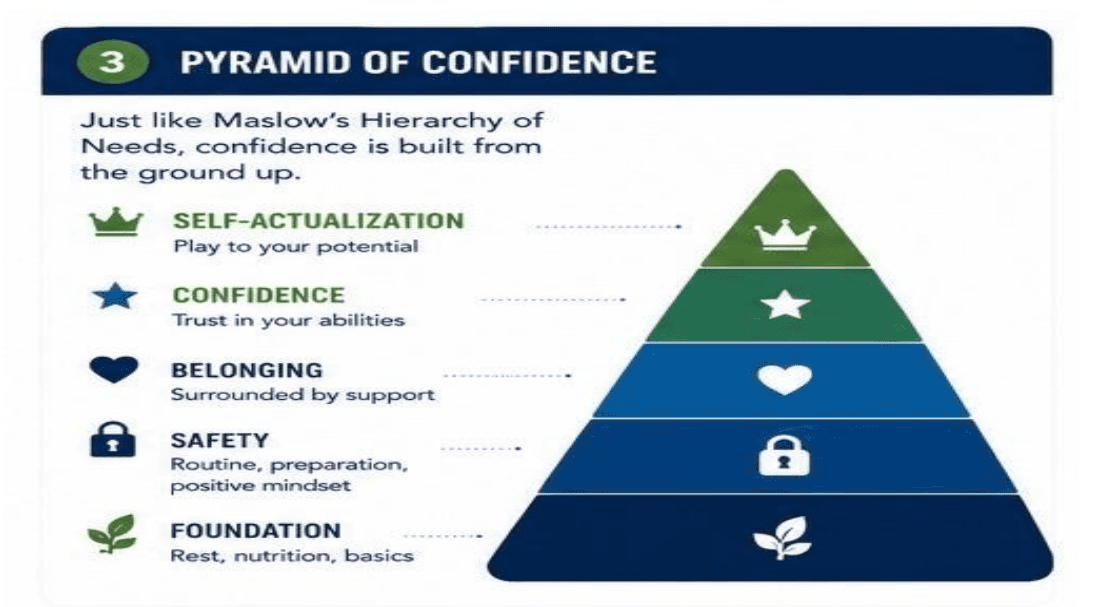
References:
Published:


